
The short version
- 1A Unicode name identifies; it does not fully define.
- 2Research meaning in the symbol's actual discipline or community.
- 3Separate fact, convention, interpretation, and uncertainty.
Begin with identity, not interpretation
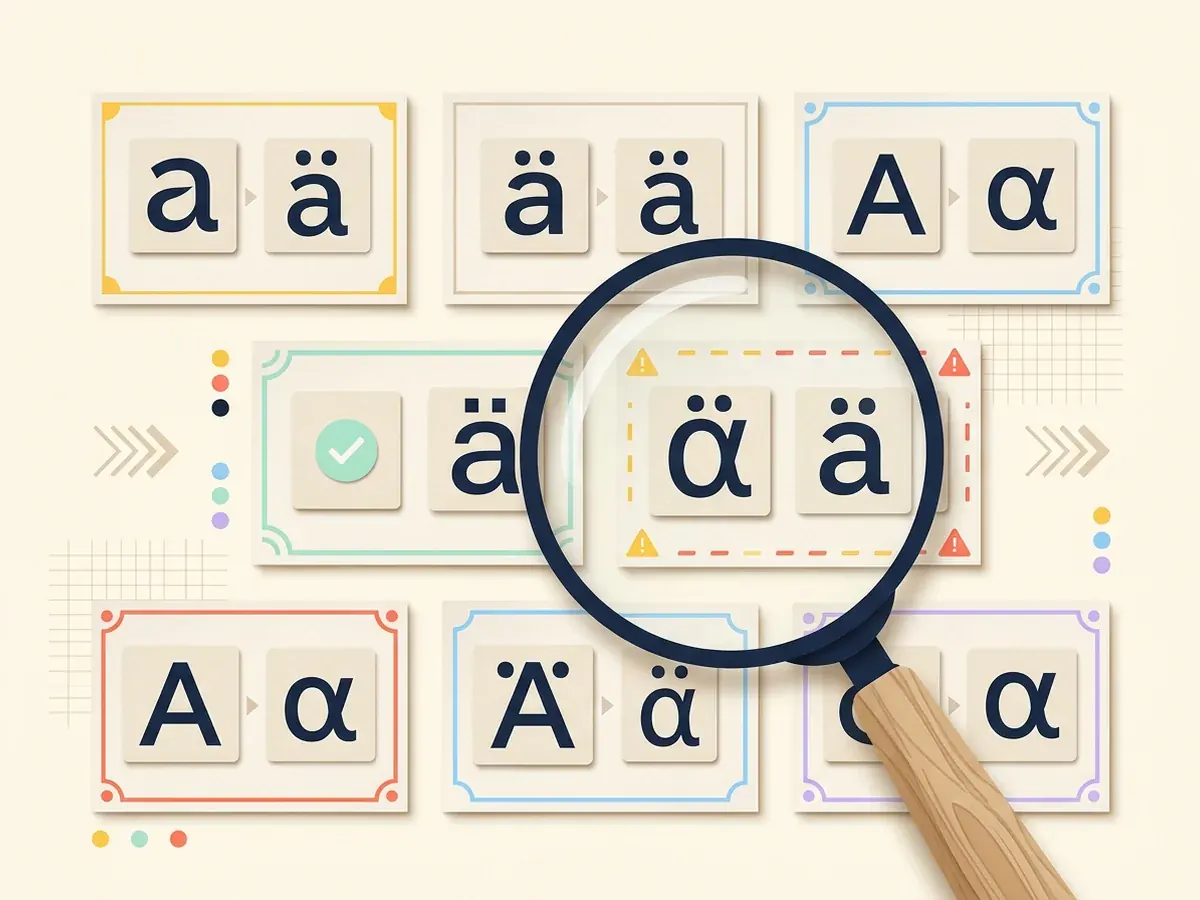
Capture the precise scalar value or ordered set, its official label, and its placement in Unicode's block map. That evidence keeps a lookalike from leading the investigation toward an unrelated history.
Unicode names are stable identifiers, not complete dictionary definitions. Some preserve historical terminology and should be read with the annotations and standard context.
Move to the relevant discipline
Mathematical operators belong in mathematical references; musical notation in music standards; religious signs in sources from the relevant traditions; emoji usage in contemporary communication research. One generic symbolism page cannot settle every context.
Separate encoded identity, conventional function, historical origin, and modern connotation. Cite each claim at the level the source actually supports.
State uncertainty and scope
Meanings change across communities and time. Avoid asserting one universal interpretation where evidence supports several, and do not turn a visual association into a historical claim.
This site's category descriptions use cautious practical guidance. They are discovery aids, while the linked primary standard remains authoritative for code-point properties.
Follow the ideas that meet here
What Is Unicode? A Practical Guide to Characters and Code Points
Technical identity gives cultural research a stable beginning. You can start with the character, code point, and glyph distinction.
Accessible Unicode Symbols: Screen Readers, Names, and Context
A documented interpretation still needs a readable presentation. You can translate visual meaning into an explicit label.
Put this guide to work
Continue with the collections below. Their copy controls, formal names, and character records connect the explanation to inspectable data.
Sources and review notes
This article was written for UnicodeSymbols.com and reviewed against the references below on September 3, 2026. The sources establish technical properties; practical recommendations are clearly presented as editorial guidance.